
You’re Getting Leads.
Too Many Are Disappearing Before Revenue.
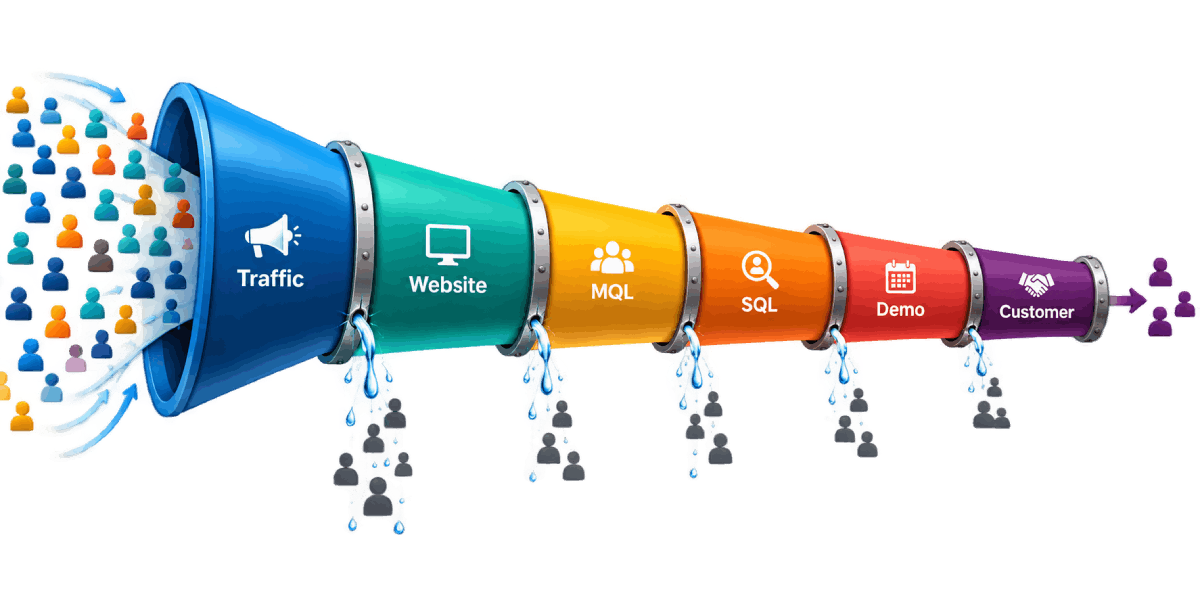
You have a proven product. You have real customers. Traffic is reaching the site, prospects are raising their hands, demos are getting booked, and opportunities are entering the pipeline.
But too many good-fit buyers stall, go quiet, or drop out before they become customers.
The Pipeline Repair Sprint™ is a focused 60–90 day engagement for founder-led B2B tech and SaaS companies that already have demand but are not converting enough of it into revenue.
We look across the full funnel to identify where good prospects lose momentum, then repair the connected messaging, website, proof, nurture, sales, and buyer-journey issues driving the drop-off.
Find the leaks, repair the connected conversion issues, and keep more good-fit prospects moving toward revenue.
Before You Spend More to Fill the Funnel, Make Sure You’re Moving the Right Prospects Through It.
When revenue growth slows, the natural reaction is often to add more activity. Increase paid media. Launch another campaign. Publish more content. Add outbound. Drive more people to the website.
Sometimes the business needs more demand.
But if good-fit prospects are already entering the funnel and too many of them fail to progress, adding more people at the top may create more lost opportunities further down.
A qualified visitor lands on the website but never takes action. An MQL never becomes an SQL. A legitimate sales prospect books a demo but does not progress. A strong opportunity seems interested, then disappears after the proposal.
You have already spent time and money earning those prospects.
Before spending more to replace them, it is worth understanding why more of them are not making it through.
Instead of treating every conversion issue as a separate marketing or sales problem, we look across the full buyer journey, identify meaningful leaks, and repair the connected issues preventing good prospects from moving toward revenue.
Focused 60–90-day implementation for B2B tech and SaaS companies with proven demand.
Keep Filling the Funnel
- Spend more for traffic
- Generate more leads
- Add another campaign
- Optimize isolated tactics
- Compensate with activity
Repair the Funnel
- Get more from existing demand
- Move more good-fit leads forward
- Fix the stage creating drop-off
- Improve the connected buyer journey
- Improve conversion
The Problem May Be Happening Between the Tactics.
Most conversion problems are not as simple as “the website is bad” or “sales is not closing.”
The campaign generates clicks. The website generates leads. Marketing qualifies them. Sales follows up. The demo explains the product. A proposal goes out.
And yet the math still does not work.
That often happens because your buyers experience the funnel as one connected journey, while the business manages it as separate marketing and sales activities.
If the ad establishes one expectation and the landing page creates another, you introduce friction. If the website generates interest but not enough urgency, sales inherits prospects who still need convincing that there is a meaningful problem worth solving. If the demo changes the value story again, the buyer has to reinterpret what they thought they understood.
Proof can create the same problem. A great case study buried three pages deep may not help the buyer at the moment they are deciding whether to trust you. A strong testimonial shown after the decision is already stalling arrives too late.
The Pipeline Repair Sprint™ examines how positioning, messaging, content, proof, conversion paths, nurture, sales conversations, and follow-up work together throughout the buyer journey.
We’ve Identified the Friction Points.
Now Let’s Repair What’s Causing the Drop-Off.
The Revenue Realignment Session™ and the Pipeline Repair Sprint™ solve different problems.
Revenue Realignment is designed primarily for companies where lead generation, pipeline, or sales momentum has slowed, and the primary blocker is not yet clear.
Pipeline Repair starts further downstream.
You already have evidence of demand. Prospects are visiting, converting, engaging with sales, or entering opportunities. There is enough real buyer activity to see that some of the right people are getting into the funnel.
The issue is that too many are not reaching the finish line.
Pipeline Repair goes beyond identifying friction. We look at where good-fit prospects lose momentum, determine what’s driving the drop-off, and make the practical changes needed to improve the path.
If the primary problem is weak buyer urgency, for example, fixing it might require adjustments to website messaging, buyer-journey content, proof, demo narrative, and follow-up.
It is one conversion problem appearing across several touchpoints.
Pipeline Repair fixes the connected system around the problem, not just the symptom where it shows up.
A Full-Funnel Review to Find Where Good Prospects Are Being Lost.
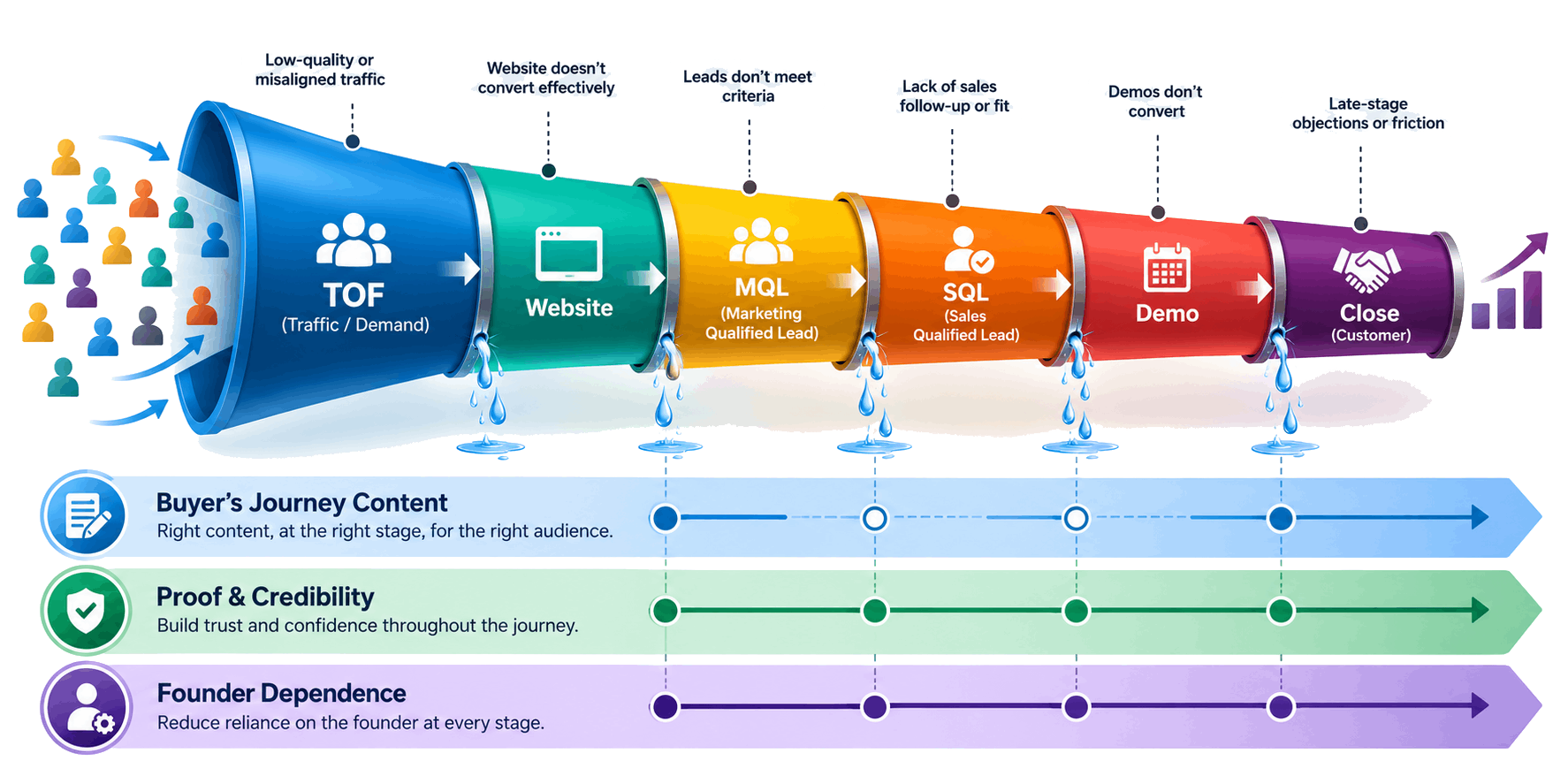
The Pipeline Repair Sprint™ begins with a full-funnel review from first meaningful touch through closed revenue.
We look at how buyers actually move through your business, not simply how the funnel appears in a diagram.
That includes your positioning, website, landing pages, calls to action, content, proof, qualification process, CRM handoffs, nurture, sales messaging, demos, follow-up, and the content buyers receive at different stages of their decision.
The goal is not to find as many problems as possible.
It is to determine where meaningful conversion loss occurs, understand what contributes to it, and focus repair work where it has the best chance of improving the buyer journey.
Top-of-Funnel Leakage
Are the right people arriving, and do they immediately understand that the offer is relevant to them?
We review traffic quality, message match, positioning, buyer recognition, initial value communication, and whether early proof gives prospects enough reason to continue.
It is whether the right visitors recognize enough relevance to move deeper into the funnel.
Website Funnel Leakage
Once the right buyer arrives, does the website help them progress, or does it make them work too hard?
We look at homepage and landing-page flow, message hierarchy, CTAs, forms, proof sequencing, conversion paths, page structure, and how well content aligns with the buyer’s stage in the journey.
It should help the right prospect understand the problem, see the relevance, build confidence, and know what to do next.
MQL-to-SQL Leakage
You are generating leads, but are enough of the right ones becoming legitimate sales conversations?
We examine lead quality, qualification criteria, nurture, scoring (when relevant), follow-up, marketing-to-sales handoff, buyer-stage content, and whether prospects receive what they need to become sales-ready.
This is also where misalignment between marketing’s definition of a good lead and sales’ definition can quietly damage pipeline performance.
SQL-to-Demo Leakage
A prospect appears qualified. Do they actually make it into the conversation with enough context and urgency to engage seriously?
We review scheduling friction, response time, pre-demo communication, nurture, expectation setting, proof, and the experience between qualification and the actual sales meeting.
This stage matters because momentum can disappear quickly when a strong prospect is interested but not yet committed to solving the problem.
Demo-to-Close Leakage
Once a legitimate buyer enters the sales process, does the experience strengthen the case for action?
We examine demo narrative, value communication, proof, objection handling, follow-up, proposal messaging, internal-buy-in support, decision friction, and whether the buyer has what they need to advocate for your solution internally.
If good opportunities consistently stall here, the problem may be less about generating more demand and more about helping existing demand reach a decision.
Cross-Funnel:
Buyer’s Journey Content Alignment
Buyers do not need the same information at every stage.
Early-stage prospects may need help recognizing the problem. Mid-funnel buyers need education, differentiation, and proof. Later-stage buyers may need validation, objection support, ROI justification, or content they can share internally.
We review whether your content does the right job at the right time, instead of simply existing in a resource library.
Cross-Funnel:
Proof & Credibility
Proof is not something to add at the bottom of a page after everything else is written.
Testimonials, case studies, customer outcomes, quantitative results, logos, third-party validation, and product evidence should appear when buyers need confidence.
We look at what proof you have, what proof may be missing, and where it should appear throughout the journey.
Cross-Funnel:
Founder Dependence
If the funnel suddenly works better whenever the founder joins the conversation, that tells us something important.
We look at what the founder is explaining, proving, contextualizing, or reframing that the website, content, sales team, or materials are not yet doing consistently.
It is to ensure conversion doesn’t depend on one person being present every time the value needs to become clear.
Conversion Optimization Is Bigger Than Cosmetic Changes.
Plenty of tools and audits can tell you a form is too long, a CTA could move higher on the page, or a button should be tested.
Those changes can matter, but they rarely provide the full answer in a complex, non-linear B2B buying journey.
It depends on whether buyers understand the problem you solve, recognize themselves in your messaging, trust your proof, understand why acting matters now, receive the right information as their questions change, and experience a consistent value story as they move from marketing into sales.
If buyers are stalling because they don’t see enough urgency or confidence to act, moving a button higher on the page won’t repair the pipeline.
What We Repair Depends on Where Buyers Are Getting Stuck.
Every company has a different buyer journey, so the Pipeline Repair Sprint™ is not built around a predetermined checklist of website edits or marketing tactics.
We start with the evidence, identify the meaningful conversion problems, and focus implementation on the connected areas required to improve them.
Depending on what we uncover, repair work may include:
Positioning & Messaging
Website & Landing-Page Conversion
Buyer’s Journey Content Alignment
Proof & Credibility
Lead Qualification & Handoff
Nurture & Follow-Up
Sales Narrative & Enablement
Align how sales explains the problem, solution, differentiation, proof, and value with the story buyers encountered before the meeting. Depending on the repair, this may include battlecards, objection handling, messaging frameworks, sales materials, or other supporting assets.
Demo Conversion
Review how the sales conversation moves from buyer problem to value, proof, differentiation, urgency, and next action.
Funnel Measurement
Define the stages and conversion points worth monitoring so you can measure improvements rather than implement them and forget them.
The Sprint focuses on the highest-impact connected conversion issues identified during the full-funnel review. It is not an unlimited rebuild of every marketing and sales asset.
You are not paying me to produce an endless list of things that could theoretically be improved.
You are paying me to find the meaningful leaks, repair the connected issues around them, and make the funnel stronger.
Find the Leaks. Repair the Issues.
Strengthen the Journey.
FIND
Identify where good-fit prospects
are losing momentum.
Review the full funnel, buyer experience, available performance data, content, proof, and marketing-to-sales handoffs.
REPAIR
Fix the connected conversion issues contributing to the drop-off.
Implement the agreed changes across messaging, website, proof, nurture, sales, content, or other relevant touchpoints.
STRENGTHEN
Carry the repair through the
surrounding buyer journey.
Make sure improvements work together so the same friction does not simply reappear at the next stage.
The goal is to create a more connected, persuasive buyer journey from initial interest through revenue.
More Than an Audit. You Leave With Actual Repair Work.
A funnel audit can tell you where conversion appears weak.
That information has value, but it often leaves the hardest part on your desk: deciding what to do about it, coordinating the changes, and finding the time to implement them.
Pipeline Leak Map™
A structured view of your funnel, the meaningful conversion points, where good-fit prospects appear to be dropping out, and which areas deserve priority.
Prioritized Repair Plan
A practical sequence showing what needs to change, which touchpoints are connected to the primary conversion problem, and what can wait.
Hands-On Conversion Repairs
Actual implementation across the agreed priority areas.
Buyer-Journey Alignment
Updates designed to create a more consistent buyer experience from marketing through sales, including the information and proof prospects need as they move closer to a decision.
Measurement Roadmap
A clear view of the stages, conversion points, and performance signals worth monitoring after implementation.
Ongoing Optimization Roadmap
Recommendations for what to monitor, test, develop, or improve after the Sprint, including areas that may benefit from ongoing fractional marketing leadership.
An Operator’s Perspective, Not Just a Conversion Audit.
I have spent more than 20 years building positioning, websites, campaigns, funnels, CRM programs, sales enablement, and revenue strategies.
I have also founded a SaaS company, conducted sales demos, handled objections, sold the product, and closed business.
I am not only looking at whether the marketing appears to be working. I ask whether the buyer has enough clarity and confidence to keep moving, whether sales is inheriting the right context, whether proof arrives at the right time, and whether the story survives as the buyer moves from the website into a real sales conversation.

PetCheck
Founded and built a first-to-market SaaS platform that helped define and fuel the growth of what became a $389M pet-care software market, delivering 4X revenue growth in its first four years and 91% customer retention in its first five.

Kokomo24/7
Partnered with leadership as the investor-backed B2B SaaS company grew from $5M to $10M, rebuilding positioning, demand generation, channel strategy, automation, and website performance.

Pipeline
Creation
Built automated HubSpot programs that generated 3,000 MQLs and 160 SQLs, along with cold-email campaigns producing 50%+ open rates, 8% landing-page CTR, and 4% conversion to demos.

Sales
Conversion
Managed strategic channel partnerships and closed three ADP deals worth more than $200,000 at 137% ROI.

Website & Conversion
Increased homepage traffic by 40% in six months after sharpening personas, use cases, messaging, and buyer relevance.
Focused 60–90 day implementation for B2B tech and SaaS companies with proven demand.
A Focused 60–90 Day Process Built Around Your Actual Funnel.
We start with how buyers actually move through your business, then repair the areas where the data shows meaningful conversion loss.
Step 1:
Map the Full Funnel
We establish the real path from first meaningful touch through closed revenue.
Step 2:
Identify the Meaningful Leaks
We combine available funnel data with the actual buyer experience to determine where good-fit prospects drop off, stall, or lose momentum.
The goal is to identify which leaks matter, what’s driving them, and which are realistically repairable within the engagement.
Step 3:
Build the Repair Plan
We connect the problem to the touchpoints that influence it.
Step 4:
Implement the Priority Repairs
This is where Pipeline Repair differs from a traditional audit.
I work with you and your team to make the agreed changes across the assets and stages contributing to the conversion problem.
Step 5:
Strengthen the Surrounding Journey
We make sure the changes work together.
Step 6:
Establish the Next Roadmap
By the end of the Sprint, you will know what was repaired, what to monitor, what still needs attention, and which opportunities should become part of the next phase of growth.
Choose the Level of Repair Your Funnel Needs.
Some funnels have one primary problem concentrated around a major stage and a manageable set of connected assets.
Others have meaningful leakage across multiple stages and require broader coordination between messaging, website, nurture, content, sales, and measurement.
That is why Pipeline Repair is available in two scopes.
FOCUSED PIPELINE REPAIR
$9,000
Typical Engagement: 60–90 Days
Best for companies where the primary conversion problem is concentrated around one major area of the funnel and its connected touchpoints.
Examples might include:
- Website funnel conversion + proof + CTA flow
- MQL-to-SQL conversion + qualification + nurture + handoff
- Demo-to-close conversion + sales narrative + proof + follow-up
Focused Pipeline Repair includes:
- Full-funnel review
- Pipeline Leak Map™
- Buyer’s journey content and proof review
- Prioritized Repair Plan
- Hands-on implementation across the primary repair area and directly connected assets
- Measurement roadmap
- Ongoing optimization recommendations
EXPANDED PIPELINE REPAIR
$15,000
Typical Engagement: 60–90 Days
Best for companies where meaningful conversion loss spans multiple stages of the funnel and requires broader implementation across the buyer journey.
This may involve several connected areas such as website conversion, qualification, nurture, proof, MQL-to-SQL handoff, sales narrative, demo conversion, and follow-up.
Expanded Pipeline Repair includes everything in Focused, plus:
- Multiple major funnel stages
- Broader website and conversion work
- More extensive copy and asset development
- Additional buyer’s journey content alignment
- Broader nurture and follow-up optimization
- Sales enablement and messaging alignment
- Greater stakeholder coordination
- More extensive implementation across connected touchpoints
We’ll determine whether Focused or Expanded Pipeline Repair fits your funnel before the engagement begins.
Not sure which scope fits?
The right level depends on where conversion is weakening, how many stages are involved, how many connected assets there are, and the internal resources available to help implement the work.
We’ll determine the appropriate scope before the engagement begins.
Built for Companies With a Proven Product and Active Demand.
The Pipeline Repair Sprint™ is designed for founder-led B2B tech and SaaS companies that already have enough activity to know there is a conversion problem worth solving.
You do need enough real buyer activity for us to understand how prospects are entering, what happens next, and where the journey begins to weaken.
This engagement is especially relevant if:
- Your website receives meaningful traffic but conversion is disappointing.
- You are generating MQLs, but too few become SQLs.
- Qualified prospects are not consistently getting to demos.
- Demos happen, but too few turn into serious opportunities or closed business.
- Good-fit prospects frequently show interest but fail to develop urgency.
- Buyers understand the product but struggle to justify the investment internally.
- Conversion improves noticeably when the founder gets personally involved.
- You are increasing acquisition spending but worry too much of that demand is being wasted downstream.
You already worked hard to create demand. Pipeline Repair helps more of the right demand survive the journey.
Probably Not the Right Fit If…
- You are pre-revenue or still validating product-market fit.
- You have little meaningful website traffic, lead flow, or sales activity.
- Your primary problem is that you are simply not generating enough demand.
- You are looking only for paid-media management or an outbound lead-generation service.
- You want a cosmetic website redesign without addressing conversion and messaging.
- You cannot provide access to the information needed to understand the buyer journey.
- You are looking for an audit or long recommendation list without intending to implement meaningful changes
Not Getting Enough Leads or Sales Momentum in the First Place?
The Pipeline Repair Sprint™ may be too far downstream.
The Revenue Realignment Session™ helps identify the primary blocker preventing stronger lead, pipeline, or sales momentum and determine where to focus first.
Repair What Is Losing Buyers Before You Replace What Is Already Working.
One of the easiest ways to waste money in marketing is to assume that under-performance means everything has to be rebuilt.
Often it is not.
The Pipeline Repair Sprint™ is intentionally built around repair before replacement.
We preserve what is already working, strengthen what is underperforming, and replace only what genuinely needs replacing.
If a larger project is necessary, I will explain why and separate it from the Sprint rather than quietly turning a focused engagement into an open-ended rebuild.
It is to make the work you already have perform better.
Keep More Good-Fit Prospects Moving Toward Revenue.
Your website does more of the explaining before sales gets involved, so prospects arrive with stronger context. Buyer-stage content answers questions as they develop rather than forcing every prospect into the same generic nurture path.
Proof starts appearing before skepticism turns into friction. Sales inherits a buyer who already understands the core value instead of having to rebuild the case from the beginning.
And when the system does more of the work, the founder does not have to rescue as many opportunities simply because they are the one person who knows how to make the value clear.
It is a more connected buyer journey that wastes less of the demand you have already earned and gives more good-fit prospects a reason to keep moving.
Repairing the Pipeline Is the First Step. Keeping It Healthy Is Ongoing.
A 60–90 day Sprint gives us enough time to understand the funnel, repair meaningful conversion issues, and strengthen the connected buyer journey.
Some companies have the internal leadership and resources to take the Pipeline Repair roadmap and own that ongoing work themselves.
Others want Simon Fractional to stay involved.
For those companies, ongoing fractional support can provide the strategic oversight, implementation, testing, messaging, content direction, sales alignment, measurement, and orchestration needed to continue improving the revenue system over time.
An ongoing Simon Fractional engagement can help make sure the system continues to evolve rather than gradually falling back into disconnected tactics.
Ongoing fractional support is available separately after the Sprint when broader implementation, leadership, and optimization make sense.
Frequently Asked Questions
Is Pipeline Repair the same as the Revenue Realignment Session™?
No.
Revenue Realignment is a complimentary diagnostic designed primarily for companies where lead, pipeline, or sales momentum isn’t where it should be, and the primary blocker isn’t yet clear.
Pipeline Repair is a paid 60–90 day engagement for companies already generating traffic, leads, demos, or opportunities but losing too many good-fit prospects before revenue.
Is this just a funnel audit?
No.
An audit identifies problems.
The Pipeline Repair Sprint™ includes a full-funnel review, diagnosis, prioritization, and hands-on implementation across the agreed high-impact conversion areas.
Why does the Sprint take 60–90 days?
Most B2B funnels involve multiple people, systems, assets, and handoffs.
We may need to review data, talk with stakeholders, revise messaging, develop or update assets, coordinate implementation, and evaluate how the changes fit together.
The 60–90 day window gives the work enough room to be thoughtful without turning it into an open-ended engagement.
Do I need perfect analytics?
No.
Better data helps, but many founder-led companies do not have perfect attribution across every funnel stage.
We use the information that exists alongside website performance, CRM data, marketing assets, sales materials, buyer behavior, and what your team is seeing in real conversations.
Will you rebuild my entire website?
Not automatically.
Pipeline Repair focuses on the assets and conversion issues contributing to meaningful drop-off.
If the website needs targeted messaging, page flow, proof, CTAs, or conversion changes, we can address those. A complete redesign or rebuild would be scoped separately if it is genuinely necessary.
What kinds of things can you actually change?
Depending on the agreed scope, repair work may include positioning and messaging, website or landing-page copy, proof, buyer-stage content, CTAs, forms, nurture emails, qualification, sales messaging, demo structure, objection handling, follow-up, and related conversion assets.
What if we have several leaks?
That is normal.
The Focused Pipeline Repair is appropriate when one primary conversion problem is concentrated around a major stage and its connected touchpoints.
The Expanded Pipeline Repair is designed for meaningful conversion loss spanning multiple stages of the buyer journey.
How do we know whether Focused or Expanded is right?
We will determine that before the engagement begins.
The right scope depends on where prospects drop off, how many stages are affected, the assets involved, and how much implementation is required.
What happens after the Sprint?
You will leave with the in-scope repairs completed, a measurement roadmap, and a prioritized view of what should happen next.
Some companies take that roadmap internally.
Others continue working with
Simon Fractional through an ongoing fractional engagement to manage implementation, optimization, messaging, content, sales alignment, and broader marketing strategy.
You Worked Hard to Generate the Demand.
Stop Letting So Much of It Disappear.
It may be getting more value from the demand you are already creating.
The Pipeline Repair Sprint™ looks across the full buyer journey to identify where good prospects lose momentum, repair connected conversion issues, and strengthen the path between first interest and revenue.
It is about making the pieces you already have work together more effectively.
Find the leaks, repair the connected conversion issues, and keep more good-fit prospects moving toward revenue.
Focused Pipeline Repair
$9,000 | 60–90 days
Expanded Pipeline Repair
$15,000 | 60–90 days
